[These are a collection of all the papers I submitted for the Distance Delta Module 1 course in preparation for the final exam. None of them make much sense without the questions, so this is a bit self-indulgent, but I'm posting them here anyway in an effort to keep track of my written work. Probably of no interest to anyone else.]
(i)
Form
The present perfect active (#1,#3,#4) consists of "have/has" plus the past participle form of the verb.
"Have" can be contracted to "'ve" as in number 4.
The past participle form can be regular, with an "-ed" ending attached to the base form of the verb (as in #4), or irregular (as in #1, #2, #3).
The present perfect passive (#2) is formed by "have/has" plus "been" plus the past participle.
Meaning/use
1. The present perfect is being used here to show that the completion of the action is imported, but the date it took place is not important.
2. The present prefect is used here to indicate that this was an event that started in the past, but continued up until the present.
3. The present perfect is being used here to indicate that the exact date that this action took place is not important.
4. The present perfect is being used here to indicate that the experience of achieving something is important, but not the actual date that it took place.
(ii).
Problems of Form
With contracted forms of the present perfect, the learners may not hear the short forms "'ve" or "'s", as in number 4.
The learners might have problems forming the past participle of the irregular verbs, such as in #1,2 and 3.
Problems of Pronunciation
In English the auxiliary verb "have/has" is not usually stressed. Putting stress on the auxiliary verb "has" will cause the sentence to sound unnatural.
*****************************************************************
Task One:
A. Gerund
B. Corpus Data
C. Immersion Learning
D. Afficate
E. Suffix
F. Diagnostic Test
Task 2
A. Jigsaw Reading: a reading that is done in pairs, where each students have some of the information and they need to share their information to construct the whole text. For example, student A is missing paragraphs 2,4, and 6, while student B is missing paragraphs 1, 3, and 5. Jigsaw readings are used to turn reading activities into communicative speaking activities.
C. Top Down Processing: A type of comprehension in which the students try to understand the meaning of the whole text instead of all the individual sentences. An example is when the teacher tells the students to read a text for gist meaning. The opposite of top down processing is examining a text sentence by sentence.
E. Stative Verb: A verb that indicates a state or condition (as opposed to an action verb). e.g. believe. Although stative verbs can be put into the present continuous in some rare occassions, beginning students are usually taught that stative verbs do not take the present continuous.
F. Notional Syllabus: A syllabus in which the emphasis is on the communicative value of grammar points, instead of teaching the form in isolation. Language points are frequently organized by their communicational function, for example, language for polite requests.
Task Two A:
Lead-in 1: To have students become familiar with the vocabulary they will be using in this lesson.
Lead-in 2: To create interest in the lesson by having students personalize the vocab.
To provide more practice with the vocabulary to aid memory retention.
Grammar 1: To have students figure out the meaning and rules for formation of the target language through a guided discovery task
Grammar 3: To provide a controlled practice for the students using the target language.
To have the students think about meaning of the target language.
Read on 1: To create interest in the topic.
To create predictions for the reading, as a way of exciting student interest in the reading.
To provide further controlled practice with the target language.
Read on 2: To provide further controlled practice for the target language
To provide comprehension questions for the reading, so that the students read for detail.
To have students use the target language in an authentic context.
Task 2 B:
1. Assumption Grammar 1: Students learn best by figuring out the rules of grammar on their own through a guided discovery.
Reason 1: It creates a feeling of self-satisfaction if the students can discover the rules on their own.
Reason 2: Anything the students discover by themselves will be retained in memory longer than something they are told by the teacher.
2. Assumption Grammar 1: It is equally important to teach the form and meaning of grammar.
Reason 1: the students need to know the form in order to recognize and correctly produce the grammar.
Reason 2: the students need to know the meaning in order to recognize the communicative value of the grammar, and to use it in the appropriate situations.
3. Assumption Grammar 1: It is useful to introduce the target language in a situational context
Reason 1: It helps students understand the meaning of the target language.
Reason 2: It helps students identify a situation in which the target language is likely to be used.
4. Assumption Read On 1: It is beneficial for the students to work with an authentic texts.
Reason 1: It increases their feeling of self-confidence in their English ability.
Reason 2: It creates a meaningful context for the language.
5. Assumption Read On 1: Controlled practice for the students is beneficial
Reason 1: It allows the students to get their heads around the language without the time pressures of natural conversation.
Reason 2: It allows the students to familiarize themselves with the form and meaning.
6. Assumption Read On 2: It is useful for students to convert language from a text into the target language.
Reason 1: It focuses attention on the meaning of the target language
Reason 2: It helps students to notice the various English expressions with similar meanings to the target language.
Task Three
Grammar 2: Having students vocalize the sentences from grammar 1 will aid in their remembering the structure they have just studied. The study of the correct pronunciation of the target language will also prepare the students for the reading and speaking partner activities in grammar 3 and Read on 1.
Grammar 4: This provides an opportunity for production for the target language practiced in Grammar 1 and 3.
Writing 1: This is an opportunity for the students to respond to the ideas in the reading activities. It provides further practice in the target language and an opportunity for freer production.
Writing 2: This provides an opportunity for the students to communicate with each other using the target language they have been studying throughout the lesson. It provides an opportunity for free production, and further generates debate, and therefore further engagement, of the reading material the students have done in the Read-On sections.
Joel Swagman:
Paper 1
|
Score
|
Tutor Comment
|
Task 1
|
2/6
Need to improve
|
You’ve done quite well with this task, Joel.
The answer is ‘corpus’, not ‘corpus data’.
Check your understanding of CLIL.
Watch your spelling: it should be affricate.
Affixation is the term you needed here.
|
Task 2
|
6/12
Satisfactory
|
One for a correct definition, one for extra information, one for an example. You can’t get the point for extra info if the definition is wrong.
Although much of the content of your 4 answers is correct, Joel, I suggest you change the layout in order to ensure that you include all appropriate information in the right place, e.g. what is the basic definition?
Definition:
Extra information:
Example:
This will make it clear to the reader what the core definition is and what the extra information is.
|
Task 2
|
8/16
7/18
(15/30)
Satisfactory
|
In (a) 2 marks for each purpose correctly identified and you can get marks for up to 8 purposes. In (b) 1 mark for each assumption and 2 more for the two reasons that support it. You can get marks for six assumptions, which accounts for 18 points.
However task 2 has a maximum score overall of 30 so if you got 34 you would still be awarded 30 in the final count.
Task 2a
Although you were able to identify purposes, you didn’t state what the TL (should/shouldn’t) was. Therefore marks couldn’t be awarded for quite a number of answers.
When describing ‘practice’, be as specific as possible: is it controlled/less controlled/free/spoken/written?
Task 2b
This section was better, Joel, but try to be as concise as possible and keep in mind that you’re referring to key assumptions about language learningin general.
It was great that you clearly stated which exercise you were referring to.
|
Task 3
|
1/10
Need to improve
|
Although your ideas were good, Joel, you again omitted to mention what the TL was.
You also need to consistently refer to preceding and future exercises, where appropriate. Your comments on Writing 1 and Writing 2 don’t mention any specifically.
Using bullet points will make it easier for you and the reader.
|
Overall Evaluation
|
P1 T1 2/6 Need to improve
P1 T2 6/12 Satisfactory
P2 T2 2 15/30 Satisfactory
P2 T3 1/10 Need to improve
|
Overall Comment
|
You’ve made a good start with this practice task, Joel!
On your answer below you will see where you have gained marks from the red ticks. The guideline answers (GLAs) are also available under CP resources/Exam reports. Take time to have a look at them to see some more points you missed out on.
Areas to work on in future tasks:
1. Adopting a different layout for some of your answers (e.g. P2 T2)would be good.
2. Always state what the TL is – don’t assume the reader knows what you mean.
|
Task One:
A. Gerund√
B. Corpus Data
C. Immersion Learning
D. Afficate
E. Suffix
F. Diagnostic Test√
Task 2
A. Jigsaw Reading: a reading that is done in pairs, where each students have some of the information and they need to share their information to construct the whole text. √ For example, student A is missing paragraphs 2,4, and 6, while student B is missing paragraphs 1, 3, and 5. √Jigsaw readings are used to turn reading activities into communicative speaking activities.√
C. Top Down Processing: A type of comprehension in which the students try to understand the meaning of the whole text instead of all the individual sentences. An example is when the teacher tells the students to read a text for gist meaning. The opposite of top down processing is examining a text sentence by sentence.
E. Stative Verb: A verb that indicates a state or condition (as opposed to an action verb)√. e.g. believe√. Although stative verbs can be put into the present continuous in some rare occassions, √beginning students are usually taught that stative verbs do not take the present continuous.
F. Notional Syllabus: A syllabus in which the emphasis is on the communicative value of grammar points, instead of teaching the form in isolation. Language points are frequently organized by their communicational function, for example, language for polite requests.
Task Two A:
Lead-in 1: To have students become familiar with the vocabulary√ they will be using in this lesson.
Lead-in 2: To create interest in the lesson by having students personalize√ the vocab.
To provide more practice with the vocabulary √ to aid memory retention.
Grammar 1: To have students figure out the meaning and rules for formation of the target language through a guided discovery task
Grammar 3: To provide a controlled practice for the students using the target language.
To have the students think about meaning of the target language.
Read on 1: To create interest in the topic.
To create predictions√ for the reading, as a way of exciting student interest in the reading.
To provide further controlled practice with the target language.
Read on 2: To provide further controlled practice for the target language
To provide comprehension questions for the reading, so that the students read for detail.√
To have students use the target language in an authentic context.
Task 2 B:
1. Assumption Grammar 1: Students learn best by figuring out the rules of grammar on their own through a guided discovery.√
Reason 1: It creates a feeling of self-satisfaction if the students can discover the rules on their own.
Reason 2: Anything the students discover by themselves will be retained in memory longer than something they are told by the teacher. √
2. Assumption Grammar 1: It is equally important to teach the form and meaning of grammar.
Reason 1: the students need to know the form in order to recognize and correctly produce the grammar.
Reason 2: the students need to know the meaning in order to recognize the communicative value of the grammar, and to use it in the appropriate situations.
3. Assumption Grammar 1: It is useful to introduce the target language in a situational context√
Reason 1: It helps students understand the meaning of the target language.√
Reason 2: It helps students identify a situation in which the target language is likely to be used.
4. Assumption Read On 1: It is beneficial for the students to work with an authentic texts.√
Reason 1: It increases their feeling of self-confidence in their English ability.
Reason 2: It creates a meaningful context for the language.
5. Assumption Read On 1: Controlled practice for the students is beneficial√
Reason 1: It allows the students to get their heads around the language without the time pressures of natural conversation.√
Reason 2: It allows the students to familiarize themselves with the form and meaning.
6. Assumption Read On 2: It is useful for students to convert language from a text into the target language.
Reason 1: It focuses attention on the meaning of the target language
Reason 2: It helps students to notice the various English expressions with similar meanings to the target language.
Task Three
Grammar 2: Having students vocalize the sentences from grammar 1 will aid in their remembering the structure they have just studied. The study of the correct pronunciation√of the target language will also prepare the students for the reading and speaking partner activities in grammar 3 and Read on 1.
Grammar 4: This provides an opportunity for production for the target language practiced in Grammar 1 and 3.
Writing 1: This is an opportunity for the students to respond to the ideas in the reading activities. It provides further practice in the target language and an opportunity for freer production.
Writing 2: This provides an opportunity for the students to communicate with each other using the target language they have been studying throughout the lesson. It provides an opportunity for free production, and further generates debate, and therefore further engagement, of the reading material the students have done in the Read-On sections.
**********************************************************************
Task four
A.
1. The advertisement uses informal language and contractions to create a friendly style,e.g. funny how that's often when things start to go wrong.
2. The first sentence is produced in large bold letters to catch the eye: Protect yourself against big garage bills today--even if your car is 11 years old.
3. The advertisement lists all the benefits of the company to encourage the reader to use the service, e.g. We cover parts and labour, including more importantly, expensive items like engines and gearboxes that can cost thousands to replace.
4. Use of the zero conditional to describe options to customers: eg if you want to stay loyal to your local garage you can.
5. Use of informal idioms to create a friendly style, e.g. getting on, clock up, pile up
B.
(i)
that: a relative pronoun being used to refer to our unique warranty
it: a singular pronoun, in this case being used to refer to the clause knowing that, as the miles clock up, garage bills won't pile up.
like: a preposition used to introduce a series of examples that fit the category expensive items.
you can: second person pronoun (used here to refer generically to the reader) followed by the modal verb can. It is being used to refer to the whole clause you can stay loyal to your local garage, but the rest of the clause is ellipted.
(ii)
that: this that is used to refer back to a noun clause already mentioned, so that the clause adds new information to an already introduced subject.
it: this is used to refer forward in the sentence to a clause not yet introduced. It creates cohesion by creating in the reader an expectation of further information, which is then later fulfilled.
like: this is used to connect the example(engines and gearboxes) with the category already introduced (expensive items).
you can: although the clause stay loyal to your local garage is not explicitly repeated, it is implied as the object of what you can do. This is an ellision. The phrase you can therefore connects the if clause to the object of the result clause.
C.
covers
Form:
* regular verb
* present tense
* 3rd person singular form (base form +s),
Use:
* An idiomatic use of the word covers meaning "extending to" as opposed to the literal meaning of an object being physically covered up.
* The present simple tense is used to imply that this is a timeless fact.
have done
Form:
* Present perfect simple
* Auxiliary verb have (in the plural form) plus the past participle verb done
* done is an irregular verb, formed by adding "ne" onto the base form of "do"
Use
*slightly informal usage
* another idiom, meaning "have travelled"
* the present perfect is used to mean that the action has started at some point in the past (presumably from the time the car was purchased) and extends to the present moment.
are getting on
Form:
* Present continuous
* phrasal verb "get on" (verb plus preposition)
* form of the be verb (the present plural form "are") plus the present participle
* get is an irregular verb
* the present participle is formed by adding "ing" to the base form, in addition to doubling the final consonant "t" because of the CVC (consonant vowel consonant) rule
Use:
* An idiomatic meaning, used to mean "becoming old"
* Different from the literal meaning of the verb "get on"--meaning to go onto a location.
* the present continuous here is used to emphasize that this is an action taking place in the present time, and is of a temporary nature i.e. to note a transition period between a car that is not old and a car that has become old, and the transition period is of a temporary nature.
D.
go wrong:
form:
* Present simple form of the verb (go) plus adjective (wrong)
* go is an irregular verb
features of connected speech:
* Because one word ends in a vowel, and the next verb begins with a lateral consonant, there is no stop between the two words.
wear and tear
form:
* two words (wear, tear) that are normally considered past simple verbs, here being used as nouns
* joined by the conjunction "and"
Features of Connected Speech
* in rhotic dialects, such as American and Scottish English, the word "wear" ends with a lateral consonant sound, which would connect with the vowel sound of the following word.
* when a /d/ sound is preceded by a /n/ sound and followed by a consonant, the /d/ sound is omitted. This is true across word boundaries, and would cause the /d/ sound at the end of and to be omitted.
Be in with a chance
Form:
* bare infinitive form of the verb "be"
* "be" is an irregular verb
* "in" is a preposition
* "with" is a preposition
* "a" is an indefinite article
* "chance" is a singular noun
Features of Connected Speech
* the vowel ending of "be" is going to connect with "in"
* the consonant ending of "with" is going to connect with "a"
Paper Two Task One
Positives
|
Negatives
|
* The test asks the student to produce a piece of writing, and as such integrates grammar, language, and fluency skills. In this way it is a direct test, and also an integrative test.
* Since the objective of the student is to improve her writing skills, a writing test is an appropriate way to test the success of the learning.
*The test is focused on a professional business situation, which is the type of writing the student is interested in.
|
* Since the student needs to use English for bookings and correspondence with customers, this may not be the most appropriate task, since it deals with an internal company memo between a boss and a subordinate. The type of language and the register used for customer service needs are quite different than the type of language used in superior-assistant correspondence.
* The writing task is too advanced for a B1 student, and may cause the student to become discouraged.
* Although in a business setting, this particular writing task (explaining why you will be away and delegating work to a subordinate) does not reflect the language needed to deal with bookings and hotel customers. In this way it lacks content validity
|
Name: Joel Swagman
Paper & Task
|
Evaluation
|
Tutor Comment
|
P1 Task 4a
|
4/5
|
You made a good start here, Joel, but make sure you don’t repeat points, e.g. the informal references are repeated in points one and five.
|
P1Task 4b
|
10
|
You did quite well with this task, but it might be easier to keep the two parts together: do Form and Cohesion for 1, and then move on to the next one.
|
P1 Task 4c
|
14
|
You did well here and provided a lot of detail and examples.
|
P1 Task 4d
|
3
|
You didn’t do so well in this one, Joel. You talked about the phonological features, rather than showing them in phonemic script. Don’t forget about sentence stress, either.
|
P2 Task 1
|
3/14
|
This answer was rather short, Joel. Laying out your answers differently might help: a positive point + a positive application.
Keep the links together.
|
Overall Evaluation
|
P1 Task 4: 31/40 Excellent
P2 Task 1: 3/14 Need to improve
|
Overall Comment
|
Joel, you’ve done quite well on these practice tasks. Thanks.
Recommendations for further development and reading:
|
Tutor:
|
A.
1. The advertisement uses informal language and contractions √ to create a friendly style,e.g. funny how that's often when things start to go wrong.
2. The first sentence is produced in large bold letters to catch √ the eye: Protect yourself against big garage bills today--even if your car is 11 years old.
3. The advertisement lists all the benefits of the company to encourage the reader to use the service √ e.g. We cover parts and labour, including more importantly, expensive items like engines and gearboxes that can cost thousands to replace.
4. Use of the zero conditional √ to describe options to customers: egif you want to stay loyal to your local garage you can.
5. Use of informal idioms to create a friendly style, e.g. getting on, clock up, pile up
B.
(i)
that: a relative pronoun being used to refer to our unique warranty
it: a singular √ pronoun √ , in this case being used to refer to the clause knowing that, as the miles clock up, garage bills won't pile up.
like: a preposition √ used to introduce a series of examples √ that fit the category expensive items.
you can: second person √ pronoun √ (used here to refer generically to the reader) followed by the modal verb can √. It is being used to refer to the whole clause you can stay loyal to your local garage, but the rest of the clause is ellipted. √
(ii)
that: this that is used to refer back to a noun clause already mentioned, so that the clause adds new information to an already introduced subject.
it: this is used to refer forward in the sentence to a clause not yet introduced. It creates cohesion by creating in the reader an expectation of further information, which is then later fulfilled.
like: this is used to connect the example(engines and gearboxes) with the category already introduced (expensive items). √
you can: although the clause stay loyal to your local garage is not explicitly repeated, it is implied as the object of what you can do. This is an ellision. √ The phrase you can therefore connects the if clause to the object of the result clause.
C.
covers
Form:
* regular verb √
* present tense
* 3rd person √ singular form √ (base form +s),
Use:
* An idiomatic use of the word covers meaning "extending to" √ as opposed to the literal meaning of an object being physically covered up.
* The present simple tense is used to imply that this is a timeless fact.
have done
Form:
* Present perfect simple √
* Auxiliary verb have √ (in the plural √ form) plus the past participle √ verb done
* done is an irregular verb, formed by adding "ne" onto the base form of "do"
Use
*slightly informal usage
* another idiom, meaning "have travelled"
* the present perfect is used to mean that the action has started at some point in the past (presumably from the time the car was purchased) and extends to the present √ moment.
are getting on
Form:
* Present continuous √
* phrasal verb "get on" √ (verb plus preposition)
* form of the be verb (the present plural form "are") plus the present participle
* get is an irregular verb
* the present participle is formed by adding "ing" to the base form, in addition to doubling the final consonant "t" because of the CVC √ (consonant vowel consonant) rule
Use:
* An idiomatic meaning, used to mean "becoming old" √
* Different from the literal meaning of the verb "get on"--meaning to go onto a location.
* the present continuous here is used to emphasize that this is an action taking place in the present time, and is of a temporary nature i.e. to note a transition period between a car that is not old and a car that has become old, and the transition period is of a temporary nature. √
D.
go wrong:
form:
* Present simple form of the verb (go) plus adjective (wrong)
* go is an irregular verb
features of connected speech:
* Because one word ends in a vowel, and the next verb begins with a lateral consonant, there is no stop between the two words.
wear and tear
form:
* two words (wear, tear) that are normally considered past simple verbs, here being used as nouns
* joined by the conjunction "and"√
Features of Connected Speech
* in rhotic dialects, such as American and Scottish English, the word "wear" ends with a lateral consonant sound, which would connect with the vowel sound of the following word.
* when a /d/ sound is preceded by a /n/ sound and followed by a consonant, the /d/ sound is omitted. This is true across word boundaries, and would cause the /d/ sound at the end of and to be omitted.
Be in with a chance
Form:
* bare infinitive form of the verb "be"
* "be" is an irregular verb
* "in" is a preposition
* "with" is a preposition √
* "a" is an indefinite article √
* "chance" is a singular noun
Features of Connected Speech
* the vowel ending of "be" is going to connect with "in"
* the consonant ending of "with" is going to connect with "a"
Paper Two Task One
Positives
|
Negatives
|
* The test asks the student to produce a piece of writing, and as such integrates grammar, language, and fluency skills. In this way it is a direct test, and also an integrative test. √
* Since the objective of the student is to improve her writing skills, a writing test is an appropriate way to test the success of the learning.
*The test is focused on a professional business situation, which is the type of writing the student is interested in.
|
* Since the student needs to use English for bookings and correspondence with customers, this may not be the most appropriate task, √ since it deals with an internal company memo between a boss and a subordinate. The type of language and the register used for customer service needs are quite different than the type of language used in superior-assistant correspondence.
* The writing task is too advanced for a B1 student, and may cause the student to become discouraged.
* Although in a business setting, this particular writing task (explaining why you will be away and delegating work to a subordinate) does not reflect the language needed to deal with bookings and hotel customers. √ In this way it lacks content validity
|
*****************************************************
Paper 1 Task 3
1. Prepositions of location
e.g. It's next to the multi-storey car par.
2. Language for expressing opinions and supporting them with reasons
e.g. I think number two is the best because it's in a busy area.
3. Language for expressing conditional futures.
e.g. If we let number 2, many people might come from the pub.
4. Turn Taking and soliciting opinions.
e.g. What do you think? Do you agree?
5. Repair strategies--Asking for clarification.
E.g. What do you mean? When you say...., do you mean that....?
Paper Two Task Four
A:
* "a text slightly above the level of the learners" reflects Krashen's theory that learners benefit most from text just slightly above their current level--i+1--because this allows them to still comprehend the main idea of the text, while hopefully noticing new language features.
* A popular criticism of Krashen's theory, one later acknowledged by Krashen himself, is that input on its own may not guarantee noticing of the language features if the learner is not consciously paying attention to them. This activity is based on the idea that some sort of language focused activity is needed to force the learners to notice the language features of the original text.
* The group work is based on Vygotskyian theory that learning happens in a community, and that learners can provide scaffolding and help to each other in the zone of proximal development.
* The belief that task based learning is beneficial because it encourages learner participation
* The fact that the test is read at a natural speed reflects the belief that students need to practice with the speed of language that they will encounter outside of the classroom.
B:
* For the purposes of focusing on spelling
* or the correspondence between written forms and spoken pronunciation.
* For the purposes of focusing on the pronunciation of words in isolation (i.e. not connected speech) before later moving onto connected speech
* For the purposes of building up learner confidence before moving onto more difficult (i.e. natural speed) listening.
* As a replacement for the last step in activity A i.e. as a way for the original text in activity A to be revealed to learners so they can compare their sentence with the original.
Name Joel Swagman
Paper & Task
|
Score
|
Tutor Comment
|
P1 Task 3
|
13/15
Excellent
|
Your answer is well laid out, Joel! Thanks!
You’ve identified a range of key features and your examples are generally level specific.
Great to see you’ve provided full examples.
Thinks to consider:
No. 1: is the example really something an Upper Int st would say?
No. 3: Which conditional structure? Be specific.
No. 4: You include turn taking and soliciting opinions together. They aren’t the same.
One point for a correct feature and 2 for a level appropriate example to go with it. Maximum 15 points.
|
P2Task 4
|
14/40
Need to improve
|
Joel, in view of a total of 40 marks, only providing 10 points is unwise as you can only score a max of 20 marks. However, a lot of what you have put is valid. I’ve numbered your points for easy reference.
Try to read the questions carefully in order to fully address requirements and thus avoid unnecessary description.
Part A:
Number 2: how necessary is the lengthy first sentence?
Part B:
Point 2: is the word ‘or’ or ‘for’? They are both really about spelling/sound, aren’t they?
Point 3: they’re not hearing the words in isolation.
Point 5: why have you made a link with Part A? You weren’t asked to.
Two marks for each point up to a maximum of 40
|
Overall Evaluation
|
P1 Task 3: 13/15 Excellent
P2 Task 4: 14/40 Need to improve
|
Overall Comment
|
Joel, you haven’t done too badly on this task.
For future tasks:
|
Tutor:
|
Joel Swagman Paper 1 Task 3
1. Prepositions of location √
e.g. It's next to the multi-storey car par.√√
2. Language for expressing opinions and supporting them with reasons√
e.g. I think number two is the best because it's in a busy area.√√
3. Language for expressing conditional futures.√
e.g. If we let number 2, many people might come from the pub.
4. Turn Taking and soliciting opinions. √
e.g. What do you think? Do you agree? √√
5. Repair strategies--Asking for clarification.√
E.g. What do you mean? When you say...., do you mean that....? √√
Paper Two Task Four
A:
- "a text slightly above the level of the learners" √√ reflects Krashen's theory that learners benefit most from text just slightly above their current level--i+1--because this allows them to still comprehend the main idea of the text, while hopefully noticing new language features.
- A popular criticism of Krashen's theory, one later acknowledged by Krashen himself, is that input on its own may not guarantee noticing of the language features if the learner is not consciously paying attention to them. This activity is based on the idea that some sort of language focused activity √√ is needed to force the learners to notice the language features of the original text.
- The group work is based on Vygotskyian theory that learning happens in a community, and that learners can provide scaffolding and help to each other √√ in the zone of proximal development.
- The belief that task based learning is beneficial because it encourages learner participation √√
- The fact that the test is read at a natural speed √√ reflects the belief that students need to practice with the speed of language that they will encounter outside of the classroom.
B:
- For the purposes of focusing on spelling √√
- or the correspondence between written forms and spoken pronunciation.
- For the purposes of focusing on the pronunciation of words in isolation (i.e. not connected speech) before later moving onto connected speech
- For the purposes of building up learner confidence √√ before moving onto more difficult (i.e. natural speed) listening.
- As a replacement for the last step in activity A i.e. as a way for the original text in activity A to be revealed to learners so they can compare their sentence with the original.
****************************************************************
Paper 1 Task 4
A:
1. Many of the verbs are in the imperative form (e.g. click, sign up, leave it, share it, track, join, help) Imperatives are used to direct the reader in how to join the organization.
2. In line 5 (simply click) an adverb is used in front of the imperative to convey the message that the suggested action requires little effort on the aprt of the reader.
3. The text uses pre-modifying adjectives in front of the noun to influence the readers’ feelings about the nouns—for example to convey positive feelings towards the organization’s service and its members (e.g. unique method, active BookCrossers) and to emphasize the importance of the resources the organization is advertised as conversing (e.g. precious resources).
4. Key words are repeated for emphasis. Adventure is in line 10, and then repeated again in line 20.
5. The repeated use of punctuation marks help to convey a sense of excitement about the subject matter (e.g. that’s it! a new reader! and more!)
B:
reads
Form: A verb which has been nominalized by adding an “s” to the base form to make it a plural noun. This is not a usual form, and would be considered ungrammatical by prescriptivists, and should be regarded as informal. Nevertheless, it’s intended meaning is easily understood.
Meaning/Use: used to mean something that is read—from the context, it is clear that this refers to books.
reader
Form: the base form of a verb plus “-er”. In English, “-er” (or sometimes “-or”) can be attached to the base form of the verb to mean a person who performs the action of the verb.
Meaning/Use: A person who reads—again, from context it is clear that this is referring to the reading of books.
Reading
Form: This is what is known as a gerund—that is, the present participle form of a verb which refers to an action, but acts grammatically as a noun. The present participle is formed with the base form of the verb (in this case read) plus “ing”.
Meaning/Use: Reading is being used in this sentence as a noun (the subject of becomes). In this sentence, it refers to the act of reading in general, or to the idea of reading, and so functions as a noun, instead of a verb.
read
Form: The full form of this verb is to be read, but “to be” is ellipted here. It is understood from the sentence structure that “to be” refers to both picked up and read. “to be read” (with “to be” ellipted) is the infinitive passive form of the verb.
Taken in context from the sentence structure, it is clear that read here is meant to refer to the past-participle form of the verb. (Although since all 3 forms of read, an irregular verb share the same spelling, and differ only in pronunciation, the spelling of the past participle is the same as that of the base verb.)
Meaning/Use: This passive construction describes what happens to the book. The infinitive here is used for the infinitive of purpose (“to be read”= “for the purpose of being read”). The passive is used because the emphasis of the passage is on what happens to the book, and not to the person who reads.
C: Bookcrossings, where 791,837 people in over 130 countries come to share their passion for books
* the relative clause starts from where and ends with books.
*Where is the relative pronoun introducing the relative clause
* As a relative pronoun, where is used as a substitute for what would normally be conveyed by the word “there” if the clause were written in traditional sentence order, i.e. 791,837 people in over 130 countries come to share their passion for books there.
* There and Where both are used to mean “the place at which”.
* In this sentence where is used as a reference for the word “at Bookcrossings”
* where is being used as the object of the relative clause, in such a way that the relative clause could be re-written 791,837 people in over 130 countries come to share their passion for books there [at bookcrossings].
* the relative clause is non-defining
* Because the relative-clause is non-defining, the relative pronoun where can not be omitted.
A book registered on BookCrossing is ready for adventure
* The relative clause is registered on BookCrossing
* registered is the past participle form of the verb “register”
* The relative clause clause is a participial clause with a past participle.
* Past participle clauses are used when the verb has a passive meaning, in this case meaning “the book is registered”.
* There is no relative pronoun. However, the sentence could be rewritten using a relative pronoun “that is registered”
* the relative clause is defining
…by others, who then do likewise
* the relative clause is who then do likewise
* the relative pronoun is who
* who refers to others
* the relative pronoun who is the subject of the clause
* the relative clause is non-defining
* the relative pronoun cannot be omitted because it is a non-defining relative clause
D.
i.
Used books
Form: used is the past participle form of use. Use is a regular verb.
Meaning/Use: used is being used as a participial adjective to describe books. As with all past participial adjectives, the meaning is passive—books that are used.
Found a BookCrossing Book?
Form: Found is the past participle form of find (an irregular verb).
Meaning/Use: Found is in the present perfect form, with the auxiliary verb have ellipted. The subject of the question you is also ellipted. The full version of the question would read Have you found a BookCrossing book?
The Present perfect is used to describe an experience in the past in which the exact date is not important.
with like-minded people
Form: like-minded is an adjective. It is composed of two different words used together to create a single lexical item. They hyphen between them indicates that they should be considered as a single lexical item. This lexical item originally came from two separate words: like, a preposition meaning “similar to” and minded, an adjective meaning “of a mind”
Meaning/use: The word is used here as a pronominal adjective to modify people. The meaning is “people of similar minds.”
as it is passed on
Form: a phrasal verb consisting of the main verb passed and the preposition on
Passed is in the past participial form.
Meaning/Use: the verb is in the passive, with the be-verb is. It describes what happens to it (the book).
ii.
used books
The correct pronunciation of used is /u:zd/, but because of the written form students might be mislead to add an extra syllable and pronounce it as /u:zəd/
as it is passed on
The word passed is pronounced /pæst/. Students, however, because of the written form of the word may add another syllable and pronounce the word as /pæsət/. They may also, because of the written form, voice the final sound as a /d/ instead of the unvoiced /d/.
Paper One Task 5
A.
Strengths
1. The writer has successfully completed the task. The incident has been reported, suitcase has been described (brown colore, it’s not big and it’s have two weels), and the inquiry to the airline has been made.
2. Inspite of many grammatical and spelling mistakes, the meaning of each sentence is not hard to understand, and the writer has successfully communicated his message. For example, the meaning of the clause I haven’t money to live in a hoter is very clear despite the fact that the negation of have wrong, and that hotel is spelled wrong.
3. The writer is able to successfully subordinate infinitive verb phrases e.g. to live in a hotel is subordinated to the main clause I haven’t money
Weaknesses
1. Spelling is a major problem, with multiple words misspelled (e.g. proplem, trevelling, fount, spook….and many many others.)
2. Overuse of “it’s”. The student uses “it’s” in contexts where the auxiliary verb “‘s” is not required, such as “It’s have too weels”
3. Although some of the verb tenses are correct, many are not, including the present simple when the present continuous is required (I write to you) and the present simple when the past simple is required (I look for it and I ask the staff).
B: I would choose to prioritize spelling for the following reasons:
* The sheer number of spelling mistakes indicates that this is a major problem for the learner.
* Many basic high frequency words (speak, was, paper, please, et cetera) are misspelled, which indicates this is a problem that the learner will have in every piece of writing, and not just writing which requires advanced vocabulary.
* The multiple attempts at self-correction on the paper indicate that spelling is a source of some anxiety for this learner, and the learner’s writing fluency will be improved by spelling, as well as the learner’s general confidence .
Name Joel Swagman
Paper & Task
|
Score
|
Tutor Comment
|
P1 Task 4a
|
4/5
|
Well done, Joel!
The 4th point is a little unclear. What does the repetition of ‘adventure’ emphasise? You’ve provided much more information in the other 4 points. You’ve made a lot of relevant points about grammar and lexis, but don’t forget features related to content & style.
Layout could be improved by using bullet points.
One mark per correct point plus example up to a maximum of 5.
|
P1 Task 4b
|
12
|
A good attempt with this task, Joel! Well done!
Things to consider:
· Layout: use bullet points.
· Don’t comment on pronunciation issues unless you’ve been asked to.
· Keep your answers succinct and avoid the use of unnecessary prose.
One mark per correct point up to a maximum of 35 for 4b, 4c and 4d.
|
P1 Task 4c
|
10
|
Lots of relevant points, Joel!
Things to work on:
· Don’t repeat points
· Mention the use of commas
· What about the ellipsis of ‘which is registered’? You say that ‘the sentence could be rewritten’ – this is too vague.
|
P1 Task 4d
|
11
Total: 37/40
Excellent
|
A good attempt, Joel!
Things to consider:
· spelling: participle
· meaning: spell out what the word(s) mean: what does happen to the book? What would you say to a st who asked you?
· Avoid unnecessary explanation of what you mean. Keep your answers brief, but concise.
· More analysis of form is needed.
|
P1 Task 5a
|
8/16
|
Joel, your points and examples are clear and are generally key ones.
However, are the ones you’ve put for Strength 3 & Weakness 2 really KEY? Are they used/not used throughout the text?
One mark per point made for each correct strength and weakness up to a maximum of 3 marks for each. One mark for each correct example/illustration up to a maximum of 3 for each correct strength or weakness (maximum 12). In addition, up to 4 additional marks for knowledge and insight into how the strengths and weaknesses aid or negate the effectiveness of the text.
|
P1Task 5b
|
1/6
Total: 9/22
Need to improve
|
Your choice of spelling is a wise choice as a priority, but the justifications aren’t well developed, Joel. Hopefully the GLAs will give you some ideas of the kinds of areas to consider.
Why is spelling possibly so important for this student?
One possible mark for each point made up to 3 marks. One additional mark is awarded for each justification that is fully developed.
|
Overall Evaluation
|
P1 Task 4 37/40 Excellent
P1 Task 5 /22 Need to improve
|
Overall Comment
|
Joel, you’ve made a good attempt at these practice tasks. Well done!
Task 4 was completed well. Just aim for greater succinctness, less unnecessary language, better layout and more attention to phonology.
Task 5b: the justifications for your choice were weak (or poorly expressed).
Keep up the good work!
|
Tutor:
|
Joel Swagman Paper 1 Task 4
A:
1. Many of the verbs are in the imperative form (e.g. click, sign up, leave it, share it, track, join, help) Imperatives are used to direct the reader in how to join the organization. √
2. In line 5 (simply click) an adverb is used in front of the imperative to convey the message that the suggested action requires little effort on the aprt of the reader. √
3. The text uses pre-modifying adjectives in front of the noun to influence the readers’ feelings about the nouns—for example to convey positive feelings towards the organization’s service and its members (e.g. unique method, active BookCrossers) and to emphasize the importance of the resources the organization is advertised as conversing (e.g. precious resources). √
4. Key words are repeated for emphasis. Adventure is in line 10, and then repeated again in line 20.
5. The repeated use of punctuation marks help to convey a sense of excitement about the subject matter (e.g. that’s it! a new reader! and more!) √
B:
reads
Form: A verb which has been nominalized √ by adding an “s” to the base form to make it a plural noun √ . This is not a usual form, and would be considered ungrammatical by prescriptivists, and should be regarded as informal √. Nevertheless, it’s intended meaning is easily understood.
Meaning/Use: used to mean something that is read—from the context, it is clear that this refers to books.√
reader
Form: the base form of a verb plus “-er” √. In English, “-er” (or sometimes “-or”) can be attached to the base form of the verb to mean a person who performs the action of the verb.
Meaning/Use: A person who reads √—again, from context it is clear that this is referring to the reading of books.
Reading
Form: This is what is known as a gerund √ —that is, the present participle form of a verb which refers to an action, but acts grammatically as a noun √. The present participle is formed with the base form of the verb (in this case read) plus “ing”.
Meaning/Use: Reading is being used in this sentence as a noun (the subject of becomes). In this sentence, it refers to the act of reading in general, or to the idea of reading, and so functions as a noun, instead of a verb.
read
Form: The full form of this verb is to be read, but “to be” is ellipted here √ It is understood from the sentence structure that “to be” refers to both picked up and read. “to be read” (with “to be” ellipted) is the infinitive passive form √ of the verb.
Taken in context from the sentence structure, it is clear that read here is meant to refer to the past-participle √ form of the verb. (Although since all 3 forms of read, an irregular verb share the same spelling, and differ only in pronunciation, the spelling of the past participle is the same as that of the base verb.)
Meaning/Use: This passive construction describes what happens to the book. The infinitive here is used for the infinitive of purpose (“to be read”= “for the purpose of being read”). The passive is used because the emphasis of the passage is on what happens to the book, and not to the person who reads. √
C: Bookcrossings, where 791,837 people in over 130 countries come to share their passion for books
* the relative clause starts from where and ends with books.
*Where is the relative pronoun √ introducing the relative clause
* As a relative pronoun, where is used as a substitute for what would normally be conveyed by the word “there” if the clause were written in traditional sentence order, i.e. 791,837 people in over 130 countries come to share their passion for books there.
* There and Where both are used to mean “the place at which”. √
* In this sentence where is used as a reference for the word “at Bookcrossings”
* where is being used as the object of the relative clause, in such a way that the relative clause could be re-written 791,837 people in over 130 countries come to share their passion for books there [at bookcrossings].
* the relative clause is non-defining √
* Because the relative-clause is non-defining, the relative pronoun where can not be omitted.
A book registered on BookCrossing is ready for adventure
* The relative clause is registered on BookCrossing
* registered is the past participle form of the verb “register”
* The relative clause clause is a participial clause with a past participle.
* Past participle clauses are used when the verb has a passive meaning √ , in this case meaning “the book is registered”.
* There is no relative pronoun. However, the sentence could be rewritten using a relative pronoun “that is registered” √
* the relative clause is defining √
…by others, who then do likewise
* the relative clause is who then do likewise
* the relative pronoun is who √
* who refers to others √
* the relative pronoun who is the subject of the clause √
* the relative clause is non-defining √
* the relative pronoun cannot be omitted because it is a non-defining relative clause
D.
i.
Used books
Form: used is the past participle form of use. √ Use is a regular verb.
Meaning/Use: used is being used as a participial adjective to describe books. As with all past participial adjectives, the meaning is passive—books that are used.
Found a BookCrossing Book?
Form: Found is the past participle form of find (an irregular verb). √
Meaning/Use: Found is in the present perfect form, with the auxiliary verb have ellipted. The subject of the question √ you is also ellipted. The full version of the question would read Have you found a BookCrossing book? √
The Present perfect is used to describe an experience in the past in which the exact date is not important.
with like-minded people
Form: like-minded is an adjective.√ It is composed of two different words used together to create a single lexical item. They hyphen between them indicates that they should be considered as a single lexical item. This lexical item originally came from two separate words: like, a preposition meaning “similar to” and minded, an adjective √ meaning “of a mind”
Meaning/use: The word is used here as a pronominal adjective to modify people. The meaning is “people of similar minds.” √
as it is passed on
Form: a phrasal verb √ consisting of the main verb passed and the preposition on
Passed is in the past participial form.
Meaning/Use: the verb is in the passive, with the be-verb is. It describes what happens to it (the book).
ii.
used books
The correct pronunciation of used is /u:zd/, but because of the written form students might be mislead to add an extra syllable and pronounce it as /u:zəd/ √
as it is passed on
The word passed is pronounced /pæst/. Students, however, because of the written form of the word may add another syllable and pronounce the word as /pæsət/. √ They may also, because of the written form, voice the final sound as a /d/ instead of the unvoiced /d/.√
Paper One Task 5
A.
Strengths
1. The writer has successfully completed the task. √ The incident has been reported, suitcase has been described (brown colore, it’s not big and it’s have two weels), and the inquiry to the airline has been made. √
2. In spite of many grammatical and spelling mistakes, the meaning of each sentence is not hard to understand, and the writer has successfully communicated his message. √ For example, the meaning of the clause I haven’t money to live in a hoter is very clear despite the fact that the negation of have wrong, and that hotel is spelled wrong. √
3. The writer is able to successfully subordinate infinitive verb phrases e.g. to live in a hotel is subordinated to the main clause I haven’t money
Weaknesses
1. Spelling is a major problem, √ with multiple words misspelled (e.g. proplem, trevelling, fount, spook….and many many others.) √
2. Overuse of “it’s”. The student uses “it’s” in contexts where the auxiliary verb “‘s” is not required, such as “It’s have too weels”
3. Although some of the verb tenses are correct, many are not, including the present simple when the present continuous is required (I write to you) and the present simple when the past simple is required √ (I look for it and I ask the staff). √
B: I would choose to prioritize spelling for the following reasons:
* The sheer number of spelling mistakes indicates that this is a major problem for the learner.
* Many basic high frequency words (speak, was, paper, please, et cetera) are misspelled, which indicates this is a problem that the learner will have in every piece of writing, and not just writing which requires advanced vocabulary.
* The multiple attempts at self-correction on the paper indicate that spelling is a source of some anxiety for this learner, and the learner’s writing fluency will be improved by spelling, as well as the learner’s general confidence . √
*******************************************************
Task One
A. Coherence Devices
B. Tense
C. Practical Test
D. Minimal Pair
E. Superordinate
F. Product Approach
Task Two
A: Idiom
A phrase which has a meaning that is different from the literal meaning of the words.
Phrasal verbs will often have an idiomatic meaning and a literal meaning.
For example look up can mean literally to look in an upwards direction, or idiomatically to research a topic.
B. Coordinating Conjunction:
A word which connects two independent clauses of a sentence.
(C.F. Subordinating conjunction, in which one clause is subordinate to the other).
Examples include "and", "but"
C. Modal Auxiliary Verb
An auxiliary verb (i.e. not the head of the verb phrase) which contains information about how the action of the verb is subjectively viewed by the speaker (i.e. the desirability, possibility, obligatory nature, et cetera).
Modal verbs are followed by the base informative form of the main verb. Negation is formed by placing "not" after the modal. (The rules are slightly different for semi-modal verbs such as "have to").
Modal verbs include: can, should, must
E. Allophone
An allophone is a set of multiple possible spoken forms to produce the same phoneme.
Allophones differ from language to language, and what is considered an allophone in one language may not be considered an allophone in another language.
In English, an example is the difference between the clear /l/ at the beginning of the word "little" the dark /l/ at the end of the same word, both of which differ in articulatory and acoustic properties, but both of which correspond to the same /l/ phoneme in English.
Task Three
1. The students will need to know vocabulary appropriate for naming locations, e.g. park, natural park, statue, landmark
2. Students will need to be familiar with adjectives, particular adjectives used to create interest and excite the readers. e.g. beautiful, fascinating, wonderful, breathtaking
3. Students will need to be familiar with modal verbs, particular modals of possibility, such as can. e.g. You can go hiking there.
4. It will also be useful for students to be familiar with how to use modal verbs for giving advice. i.e. You should visit this park.
5. Students will need to be familiar with the style of writing titles in English, which typically consist of a noun phrase only, i.e. The Most Beautiful Places in my Country.
6. Students will also need to be familiar with the capitalization rules of titles in English, which is all the content words in a title, i.ie. The Most Beautiful Places in my Country.
Paper Two Task Four
a.
* L1 and L2 language are separate language systems and so must be kept separate. Constant reference to the L1 will result in more L1 interference.
* Using the L2 as a medium of classroom instructions will increase L2 exposure for the students, and create a more immersive classroom environment.
* Constant exposure to the L2 may result in acquisition in the same way that children learn their L1.
* Related to the above point, possibly the belief that at least at some limited level an immersive environment can be created in a foreign language classroom, despite the obvious time constraints
* Students may be able to do and understand more in the L2 than they realize, but some of them lack confidence and could revert to the L1 if given an option. Students must be forced to use and comprehend the L2 in order to realize their full potential.
* The belief that students should be trained to "think" in the L2 by producing sentences spontaneously in the L2, instead of first formulating their ideas in their L1, and then translating to the L2.
b.
* At the beginning of the term, teachers can teach the students a list useful classroom phrases in English, which can then be used to introduce a variety of classroom activities.
* The teacher can accompany any explanation in English with visual demonstrations or visual aids.
* The teacher can use concept checking questions to help explain an activity in English.
* Prior to a discussion, the teacher can have the class brainstorm useful vocabulary for the topic. The class will activate what knowledge they already know, and also become aware of what vocabulary they are lacking to discuss the topic. The teacher can provide any lacking vocabulary.
* Instead of using L1 as the default mode, use English as the default mode of instruction, and only revert to L1 explanations when there is a breakdown in communication.
* For teacher 4 especially, a technique could be borrowed from the community language learning practice, in which the students first say their ideas in the L1, and then the teacher helps them translate it into English.
c.
* According to some viewpoints, beginning level students have a right to silence, and should not be forced to use the L2 before they feel ready to. These students can do activities which require them to comprehend English, but can respond in their L1.
* Related to the above point, it could be argued that students should be free to revert to their L1 in any student-to-student interaction in which the students feel more comfortable in their L1. That is, the students should take control of their learning and decide when to use the L2, and when they are more comfortably communicating in the L1.
* In order to prevent L1 interference, some teachers may choose to directly draw attention to the differences between the L1 grammar and the L2 grammar. Some examples from the L1 would be necessary to do this.
* At lower levels, when the students do not possess the necessary meta-language in English, learning may be facilitated if the teacher uses the L1 to explain the grammar.
Paper & Task
|
Score
|
Tutor Comment
|
P1 Task 1
|
4/6
Good
|
Try to not leave blank answers, Joel.
One mark per correct answer.
|
P1Task 2
|
9/12
Excellent
|
Well done, Joel!!!!!
Check modal verb: what do you mean by informative form?
Allophone: your definition isn’t accurate (you need to mention ‘variation’), but your example is.
Three possible marks per term, maximum total 12 marks. One mark per core definition, one mark for extra relevant information (only if core definition is correct), one mark for a correct example. If more than four attempted, marks are awarded for first four responses.
|
P1 Task3
|
9/15
Satisfactory
|
Joel, a few things re this task:
You’ve listed modal verbs twice. Try to avoid doing this.
6 isn’t marked, because you were asked for 5. In addition, is it a key language feature? Point 5 needs much more information and is it a key language feature?
Three possible marks per correct answer, maximum total of 15 marks. One mark for each correct language feature. Two marks for one correct example/illustration.
|
P2 Task 4
|
24/40
Satisfactory
|
You’ve done quite well with this section, Joel!!
Try not to repeat points, though.
4a: a number of the points deal with immersion. In tasks like this, try to keep the points quite separate.
4b: concept checking questions check understanding, not instructions.
Two marks per correct point up to a maximum of 40 marks.
|
Overall Evaluation
|
P1 Task 1 4/6 Good
P1 Task 2 9/12 Excellent
P1 Task 3 9/15 Satisfactory
P2 Task 4 24/40 Satisfactory
|
Overall Comment
|
Joel, you’ve done well with Tasks 1 & 2!!!!!!!!! Keep it up!
You will improve the marks for Tasks 1, 2 & 3 by continuing your work on becoming familiar with terminology, ensuring that your examples are actually correct and providing complete/accurate definitions, e.g. what do you mean by ‘base informative form’?
The information you provide in Task 3 is generally satisfactory, but you’ve ignored a lot of other features of successful writing. When completing questions like this, think about your own Pre-Intermediate level students. Would they be able to write titles like this and use capital letters appropriately?
In Task 4 you provided a lot of points for each section – well done!!!!
What you need to focus on is keeping the same points together and being precise, though.
Best wishes with Unit 7!
|
Tutor
|
Task One Joel Swagman
A. Coherence Devices
B. Tense √
C. Practical Test
D. Minimal Pair √
E. Superordinate √
F. Product Approach √
Task Two
A:Idiom
A phrase which has a meaning that is different from the literal meaning of the words. √
Phrasal verbs will often have an idiomatic meaning and a literal meaning. √
For example look up can mean literally to look in an upwards direction, or idiomatically to research a topic. √
B. Coordinating Conjunction:
A word which connects two independent clauses of a sentence. √
(C.F. Subordinating conjunction, in which one clause is subordinate to the other). √
Examples include "and", "but"√
C. Modal Auxiliary Verb
An auxiliary verb (i.e. not the head of the verb phrase) which contains information about how the action of the verb is subjectively viewed by the speaker (i.e. the desirability, possibility, obligatory nature, et cetera). √
Modal verbs are followed by the base informative form of the main verb. Negation is formed by placing "not" after the modal. (The rules are slightly different for semi-modal verbs such as "have to").
Modal verbs include: can, should, must √
E. Allophone
An allophone is a set of multiple possible spoken forms to produce the same phoneme.
Allophones differ from language to language, and what is considered an allophone in one language may not be considered an allophone in another language.
In English, an example is the difference between the clear /l/ at the beginning of the word "little" the dark /l/ at the end of the same word √ , both of which differ in articulatory and acoustic properties, but both of which correspond to the same /l/ phoneme in English.
Task Three
1. The students will need to know vocabulary appropriate for naming locations √, e.g. park, natural park, statue, landmark √√
2. Students will need to be familiar with adjectives, particular adjectives used to create interest and excite the readers √. e.g. beautiful,fascinating, wonderful, breathtaking √√
3. Students will need to be familiar with modal verbs, particular modals of possibility √ , such as can. e.g. You can go hiking there. √√
4. It will also be useful for students to be familiar with how to use modal verbs for giving advice . i.e. You should visit this park.
5. Students will need to be familiar with the style of writing titles in English, which typically consist of a noun phrase only, i.e. The Most Beautiful Places in my Country.
6. Students will also need to be familiar with the capitalization rules of titles in English, which is all the content words in a title, i.ie. The Most Beautiful Places in my Country.
Paper Two Task Four
a.
* L1 and L2 language are separate language systems and so must be kept separate. Constant reference to the L1 will result in more L1 interference. √√ 1
* Using the L2 as a medium of classroom instructions will increase L2 exposure for the students, and create a more immersive classroom environment. √√ 2
* Constant exposure to the L2 may result in acquisition in the same way that children learn their L1. (2)
* Related to the above point, possibly the belief that at least at some limited level an immersive environment can be created in a foreign language classroom, despite the obvious time constraints (2)
* Students may be able to do and understand more in the L2 than they realize, but some of them lack confidence and could revert to the L1 if given an option. Students must be forced to use and comprehend the L2 in order to realize their full potential. √√3
* The belief that students should be trained to "think" in the L2 by producing sentences spontaneously in the L2, instead of first formulating their ideas in their L1, and then translating to the L2. √√4
b.
* At the beginning of the term, teachers can teach the students a list useful classroom phrases in English, which can then be used to introduce a variety of classroom activities.√√5
* The teacher can accompany any explanation in English with visual demonstrations or visual aids.√√6
* The teacher can use concept checking questions to help explain an activity in English.
* Prior to a discussion, the teacher can have the class brainstorm useful vocabulary for the topic. The class will activate what knowledge they already know, and also become aware of what vocabulary they are lacking to discuss the topic. The teacher can provide any lacking vocabulary. √√7
* Instead of using L1 as the default mode, use English as the default mode of instruction, and only revert to L1 explanations when there is a breakdown in communication. √√8
* For teacher 4 especially, a technique could be borrowed from the community language learning practice, in which the students first say their ideas in the L1, and then the teacher helps them translate it into English. √√9
c.
* According to some viewpoints, beginning level students have a right to silence, and should not be forced to use the L2 before they feel ready to. These students can do activities which require them to comprehend English, but can respond in their L1.√√10
* Related to the above point, it could be argued that students should be free to revert to their L1 in any student-to-student interaction in which the students feel more comfortable in their L1. That is, the students should take control of their learning and decide when to use the L2, and when they are more comfortably communicating in the L1. (10)
* In order to prevent L1 interference, some teachers may choose to directly draw attention to the differences between the L1 grammar and the L2 grammar. Some examples from the L1 would be necessary to do this. √√ 11
* At lower levels, when the students do not possess the necessary meta-language in English, learning may be facilitated if the teacher uses the L1 to explain the grammar.√√ 12
*************************************************************
Task Two
A.
Exercise 14:
To provide a context for the target language.
Exercise 15:
To practice the grammar of the target language.
Exercise 17:
To learn useful collocations for the target language.
Exercise 18a
To identify meaning of useful words and phrases associated with the target language.
Exercise 18b
To collect and identify phrases which are similar in meaning.
B.
Assumption: (Ex 15, 17, 18a, 18b)
Students learn better by first trying to work out the rules of the language themselves instead of being told the rules.
R1:
The cognitive engagement of guided discovery causes the rules to be retained better in the memory.
R2:
It is possible for a student to be inattentive while passively listening to an explicit explanation, but a guided discovery forces the students to become attentive.
Assumption: (Ex.14)
It is useful for the students to hear the useful language in context
R1:
The context of the language helps students to understand the meaning of the language.
R2:
Putting the language in context helps students understand why they are learning it, and thus increases the motivation
Assumption (Ex. 17)
It is useful for students to learn collocations
R1:
As argued in the Lexical Approach by Michael Lewis, much of language use is pre-fabricated chunks, or lexical phrases, rather than individual words in isolation.
R2:
Many of these collocations would not be evident from a knowledge of grammar alone, and students need special focus in order to be accurately learnt.
Assumption (Ex. 18b)
It is useful for students to group together words with similar meanings
R1:
It draws students attention to the fact that there are many different ways of expressing the same idea in English.
R2:
Giving students a range of expressions gives them more flexibility in language choice in their own production.
Assumption (Ex 15)
In addition to knowing the correct grammar and collocations, students need to learn the register of the language (formal/polite vs. informal)
R1:
The context of language determines its appropriateness.
R2:
Unlike native speakers, learners do not have an innate sense of the appropriateness of language, and need to have their attention drawn to it.
Assumption (Ex 14)
Before focusing on the target language, it is useful to do an exercise focusing on general understanding.
R1:
It gives support and builds confidences
R2:
meaning first provides the context for language and encourages an initially more global way to listen
Task Three:
* It provides extra practice for the language introduced in Ex 18a. (Ex 19)
* It provides more practice on the subject of the register of the target language introduced in 15 (Ex 21)
* It provides controlled practiced for the target language introduced in Ex. 15, 17, 18. (Ex. 19, 21)
* It provides production opportunities for the language introduced in Ex. 15, 17, 18 (Ex. 22)
* Using the target language introduced in Ex 14, 15, 17, 18, it moves the students from passive reception (reading and listening) to active production (speaking and writing) in Ex. 21, 22.
*It provides more examples of the target language introduced in Ex. 14, 15, 17 and 18. (Ex. 19)
Name: Joel Swagman
Paper & Task
|
Score
|
Tutor Comment
|
P2 Task 2a
|
0/16
|
Joel, in Task 2a, you MUST state what the target language is, i.e. making requests and appropriate responses in order to get the marks.
For 15, what do you mean ‘to practise the grammar of the target language’? You need to be much more succinct and refer to gerund/infinitive.
For 18b, what do you mean by ‘phrases which are similar in meaning’? Isn’t it a focus on ways of making positive responses to a request which involve the issue of the response looking negative, e.g. ‘No problems’ (a rather long sentence, I know – hope it makes sense, Joel)?
You also need to supply more than one purpose for each exercise. The GLAs should give you some ideas here, Joel.
Two marks per correct purpose up to a maximum of 16 (8 purposes). More than one correct purpose is possible for each exercise.
|
P2Task 2b
|
10/18
Total 10/30
Need to improve
|
I’ve added in numbers for easier reference, Joel.
A number of reasons refer to the importance of context. Try to provide greater variety in your reasons. Some of your ‘reasons’ are just statements, e.g. Ass. 3 R. 1
Some of your reasons deal with behaviour issues, Ass. 1, R. 2: ‘forces sts to be attentive’ or reasons for coming to class (Ass. 2, R.2).
Assumption 5: one of your reasons suggests that English speakers are the only ones who have degrees of formality. How reasonable is this? Is this really what you mean, Joel?
One mark per key assumption up to a maximum of 18. And, up to two marks for the underlying reason behind each assumption. A reason given under a particular assumption will be accepted under another assumption if it is relevant. Reasons can only be credited once across all assumptions.
|
P2 Task 3
|
2/10
Need to improve
|
Joel, it was good to see that you referred consistently to the exercises.
There were a few problems with the answers you provided for this task, though.
Did you do the tasks yourself? Did you have time to look carefully at the materials?
You’ve only provided 6 points.
The heading for Ex 19 is ‘Pronunciation: intonation clues’ yet you make no mention of pronunciation in your answer at all.
You don’t mention what the target language is: try to be more precise, and state whether it is the requests/responses (which ones)/both.
Your use of the term ‘practice’ is vague, and in the exam you need to specify whether it is spoken or written and how controlled/less controlled/free it is.
One mark for each correct point made up to a maximum of 10 marks.
|
Overall Evaluation
|
P2 Task 2 10/30 Need to improve
P2 Task 3 2/10 Need to improve
|
Overall Comment
|
The layout throughout was great, JoeI.
It was a shame you didn’t handwrite the tasks.
Did you manage to get them done in the suggested time?
You’re probably disappointed with your score, but you did well with 2b.
It’s now a matter of
With the mock exam next week, please do handwrite it as it will give you an idea of your ability to get it all done in the time available.
Best wishes
DD
|
Tutor:
|
Task Two
A.
Exercise 14:
To provide a context for the target language.
Exercise 15:
To practice the grammar of the target language.
Exercise 17:
To learn useful collocations for the target language.
Exercise 18a
To identify meaning of useful words and phrases associated with the target language.
Exercise 18b
To collect and identify phrases which are similar in meaning.
B.
- Assumption: (Ex 15, 17, 18a, 18b)
Students learn better by first trying to work out the rules of the language themselves instead of being told the rules. √
R1:
The cognitive engagement of guided discovery causes the rules to be retained better in the memory.√
R2:
It is possible for a student to be inattentive while passively listening to an explicit explanation, but a guided discovery forces the students to become attentive.
- Assumption: (Ex.14)
It is useful for the students to hear the useful language in context √
R1:
The context of the language helps students to understand the meaning of the language.√
R2:
Putting the language in context helps students understand why they are learning it, and thus increases the motivation
- Assumption (Ex. 17)
It is useful for students to learn collocations √
R1:
As argued in the Lexical Approach by Michael Lewis, much of language use is pre-fabricated chunks, or lexical phrases, rather than individual words in isolation.
R2:
Many of these collocations would not be evident from a knowledge of grammar alone, and students need special focus in order to be accurately learnt.
- Assumption (Ex. 18b)
It is useful for students to group together words with similar meanings √
R1:
It draws students attention to the fact that there are many different ways of expressing the same idea in English.
R2:
Giving students a range of expressions gives them more flexibility in language choice in their own production.
- Assumption (Ex 15)
In addition to knowing the correct grammar and collocations, students need to learn the register of the language (formal/polite vs. informal) √
R1:
The context of language determines its appropriateness.√
R2:
Unlike native speakers, learners do not have an innate sense of the appropriateness of language, and need to have their attention drawn to it.
- Assumption (Ex 14)
Before focusing on the target language, it is useful to do an exercise focusing on general understanding.√
R1:
It gives support and builds confidences
R2:
meaning first provides the context for language and encourages an initially more global way to listen √
Task Three:
* It provides extra practice for the language introduced in Ex 18a. (Ex 19)
* It provides more practice on the subject of the register of the target language introduced in 15 (Ex 21)
* It provides controlled practiced for the target language introduced in Ex. 15, 17, 18. (Ex. 19, 21)
* It provides production opportunities for the language introduced in Ex. 15, 17, 18 (Ex. 22) √
* Using the target language introduced in Ex 14, 15, 17, 18, it moves the students from passive reception (reading and listening) to active production (speaking and writing) in Ex. 21, 22. √
*It provides more examples of the target language introduced in Ex. 14, 15, 17 and 18. (Ex. 19)


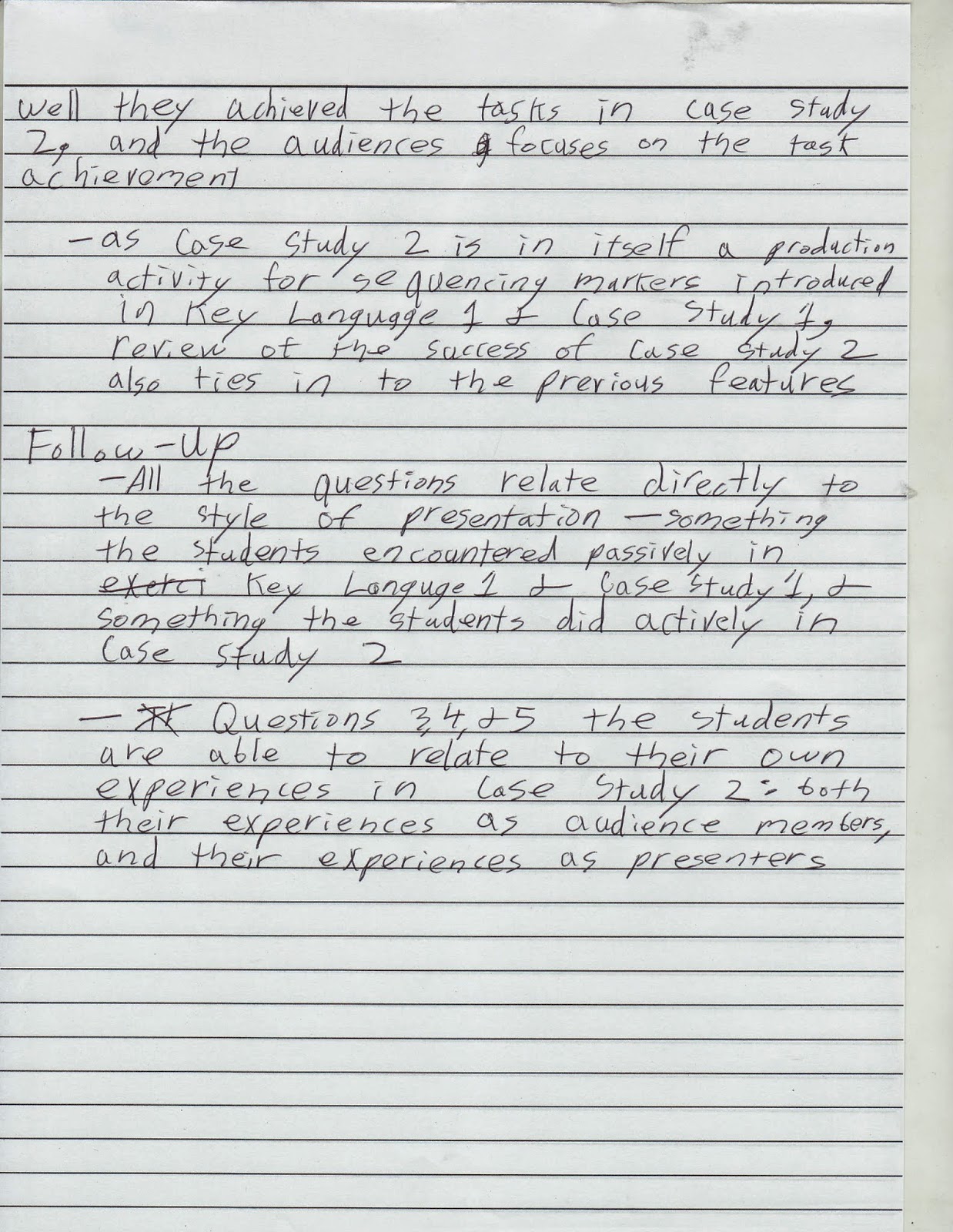


Name: Joel Swagman
Paper 1
|
Score
|
Tutor Comment
|
Task 1
|
5/6
|
Well done, Joel!
You get one point per correct item.
a) √
b) √
c) √
d) √
e) √
f)
|
Task 2
|
6/12
|
Try to make your definitions more precise, Joel.
Layout could be better, e.g.
Definition:
Extra:
Example:
Only the 1st 4 are marked!
e.
Def: not partially blocked???
extra is Ok, but no mark
Example √
f.
Def.√
Ex:
Eg:√
b.
Def.X
Ex:X
Eg:X
d.
Def.√
Ex:√
Eg:√
One for a correct definition, one for extra information, one for an example. You can’t get the point for extra info if the definition is wrong.
|
Task 3
|
3 /15
|
The problem with your answer to this task, Joel, is that you’ve only addressed grammar/lexis.
You need to think about why the speakers would use the language: look at the instructions for the task. ‘Try to sell your things to a partner. They should try to get a discount’. What do human beings do in conversations like this?
1.√√√
2.X
3.X
4.X
5.X
One point for a correct feature and 2 for a context and level appropriate example to go with it. Maximum 15 points.
|
Task 4
|
18/40
(2/5)
(16)
|
Joel, this wasn’t too bad.
In a. keep the text in mind, not this particular example of the text. It’s a promotional leaflet.
In b. Watch spelling!!! Try to lay your answers out more clearly, as well.
Provide full information, e.g. present perfect simple/continuous; spelling issues; be clearer about reg v irreg verbs; supply the auxiliary; deal with aspects of pronunciation.
a.
1.√
2.X (not in GLAs)
3.√
4.keep the text in mind – a promotional leaflet (not just about youngsters)
5. no contractions – part of point 3.
b.
imperative√
transitive√
indirect object√
direct object (break)√
idiomatic an opportunity√
You lose all points re participle because of incorrect spelling!!!!!!!!!
regular verb identify√
passive√
past participle√
regular verb√
unimportant to meaning√
aux ‘have’√
reg verb return√
part of infinitive√√
intro prep phrase√√
One point for each item up to 40 points. In part (a) you only get the mark if you give an example and you get a maximum of 5 points. For the rest of the tasks there is no restriction on where you score points.
|
Task 5
|
(12/16)
16/22
|
Joel, you’ve identified 3 of each and provided an example. Great!
However, you’ve said nothing about the effect on the reader (losing potential marks) and you haven’t referred to anything other than grammar and spelling when commenting on Strengths & weaknesses.
Strengths:
1.√√
2.√√
3.√√
Weaknesses:
1.√√
2.√√
3.√√
Choice√
Reasons√√√
1 point for the strength or weakness and there should be 3 of each; 1 for the examples that go with these; 4 extra points for comments on why and how these things make the text more or less effective.
|
Paper 2
|
Score
|
Tutor Comment
|
Task 1
|
6/14
|
Your points are great Joel, but you haven’t said enough about the connection to the learner and how these points are going to affect his/her performance.
1.√
2.√
3.X
4.√
5.√
6.√√
1 mark for each point you make and a further mark for the connection to the learner – this holds true for up to 6 points total, there must be both positives and negatives but may not be three of each. 2 extra points available for good use of terminology
|
Task 2
|
(2/16)
(5 /18)
7/30
|
The problem with A, Joel, is that you haven’t referred to the preparation for/giving presentations at all. You mention TL, but the aim is really the presentations (look at the heading of the 2 pages). Look more carefully at all the exercises and think about the aim of each (in the context of preparing & giving a presentation). Why would you do these tasks with your students?
In b most of your assumptions are OK, but try to use more terminology, e.g. focus on accuracy, work collaboratively, cognitively challenging.
A lot of your reasons are repetitious and are very weak. Think about language learning. The GLAs should help here.
A.
KL 1
1. X not clear enough, Joel.
CS 1
describing graphs √√
CS 2
X
B.
A1 R 1 R2: is this about key assumptions about language learning?
A2√ R1X R2√
A3√ R1x R2x
A4√ R1 x R2x
A5X R1X R2X
A6 √ R1 X R 2X
In (a) 2 marks for each purpose correctly identified and you can get marks for up to 8 purposes. In (b) 1 mark for each assumption 2 more for the two reasons that support it. You can get marks for six assumptions, which accounts for 18 points. However, Task 2 has a maximum score overall of 30 so if you got 34 you would still be awarded 30 in the final count.
|
Task 3
|
7/10
|
Joel, well done with this task! However, as in many of your answers, I suggest you try to be more succinct and use fewer words to convey your message!
KL 3
√
√
CS 3
√
√ (your first point really includes 2 points: separate your answer)
√
Follow up
√
√
1 mark for each point you make up to a maximum of 10
|
Task 4
|
18/40
|
I suggest you use fewer words, Joel, and make a list of brief points – look at the GLAs for ideas. In A, 4 & 5 are very similar (and aren’t in the GLAs).
try to leave more time for this task as it carries a lot of marks! You’ve got a lot of good ideas – you just need more!
A.: 5 points
1. methodology √√
2. syllabus√√
3. difficult to measure√√
4. should come after receptive skills?
5. do after sts have mastered a lot of other language?
B. 6 points
1. work/life needs √√
2. different language features √√
3. similar to 4 – impact on other skills
4. Impact on reading √√
5. develop accuracy √√ (just)
6 learner motivation √√
7. study needs √√
Two marks for each point up to a maximum of 40
|
Overall Evaluation
|
48/ 95 = 51 %
38/ 94 = 40 %
Total = 48 + 38 = 86/189 = 46 %
|
Overall Comment
|
Joel, while you may be disappointed with the result, you’re definitely on the right track, and you’ve got a lot of good things in here!!
My suggestions of what to focus on are:
- provide as much info as you can on Meaning/Use/Form/Pronunciation and make sure it’s complete. Separate your points. Use terminology.
- be more precise. You’ll notice in nearly question I’ve said that you need to use fewer words and make brief points. This has a two- fold result: your message is clearer and you’ll save time.
- read the instructions carefully, e.g. Paper 1 T3: you only spoke about grammar/lexis. The sts had a conversation; P1 T4: it’s a promotional leaflet – not just one about a charity. Again, you mainly focused on grammar/lexis.
- try to provide more answers (in case some of them are not correct), e.g. P2 T2 Part a is worth 16 marks and Part b 18: the question uses the words ‘key assumptions about language learning’ (in general). Try to provide solid reasons.
- ensure you have time to answer questions which carry a lot of marks.
Good luck in the exam! Best wishes.
|
Tutor:
|


